Customer service trends in April 2026 are clear. AI in customer service is no longer just an experiment. It is now moving into production, metrics and executive leadership discussions. At the same time, research highlights another equally important phenomenon. Leadership often sees development much more positively than customers and employees working in customer facing roles. This gap is currently the biggest risk for CX leadership.
AI moves from experiments to structures
In recent weeks, Europe has shown a strong signal that the next phase of contact center development will not start with new channels but with simplifying the overall structure. Puzzel’s Europe focused State of Contact Centres 2026 study is based on responses from 1 505 contact center professionals in the United Kingdom, the Netherlands, Sweden, Norway and Denmark.
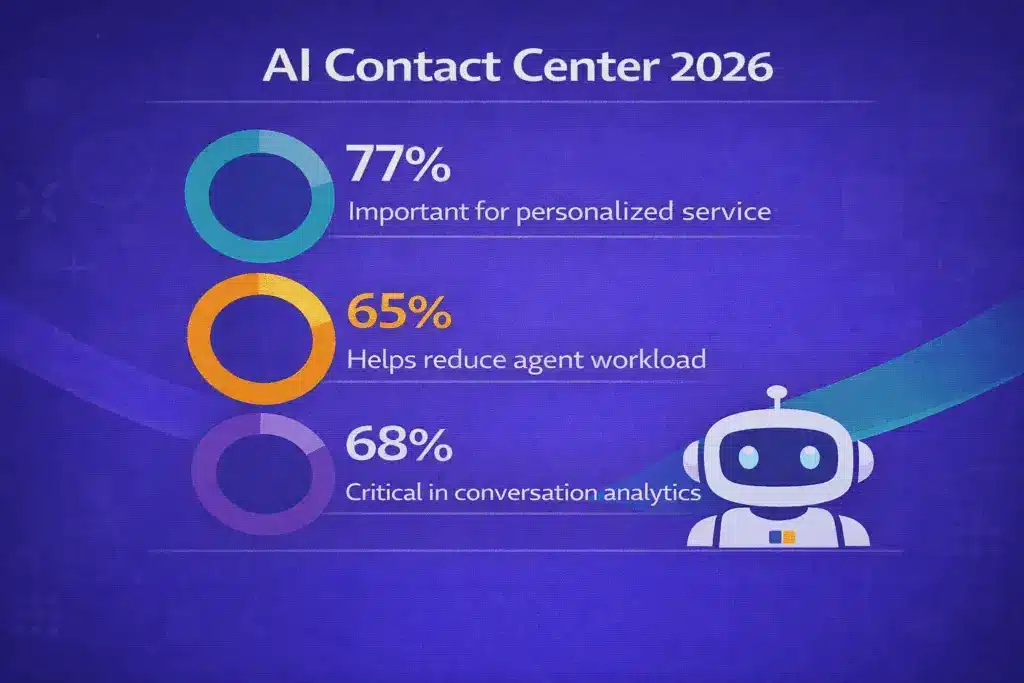
According to the study, 94 percent consider technology stack consolidation essential, 77 percent say AI is important for personalized service, 65 percent see AI tools as key to reducing agent workload and 68 percent believe conversation analytics is a critical capability. This is important for leadership because the value of AI no longer comes from a single bot but from how well data, channels and workflows work together.
At the same time, global studies show increasing pressure for results. Deloitte reports that 64 percent of service leaders say AI has improved agent productivity and 39 percent say cost per contact has decreased. In addition, 43 percent believe AI can enable more than 30 percent cost reduction in contact centers over the next three years. The message for leadership is clear. Expectations are now high so AI initiatives are evaluated based on business impact rather than interest.
The biggest risk is not technology but the experience gap
This is where a dangerous misconception emerges. According to Medallia’s State of Customer Experience report 2026 report published in March, 66 percent of brands believe CX has improved but only 17 percent of consumers agree.
In addition, between 30 and 40 percent of organizational units do not operate based on critical customer insight. This is especially important now because in many organizations AI increases the amount of data faster than the ability to turn it into decisions. If leadership does not change, technology will only increase visibility into problems without solving them.
Intercom’s Customer Service Transformation Report 2026 supports the same observation from another angle. The report is based on 2 470 customer service professionals across different regions. According to the report, 82 percent of executives invested in AI for customer service in 2025 and 87 percent plan to invest in 2026, but at the same time a growing gap is emerging between surface level use and deeply integrated use of AI.
The practical conclusion is this. Competitive advantage does not come from using AI but from integrating it into core processes, data, metrics and continuous improvement.
Customer interactions matter more than technology
On the employee experience side, the signals are just as strong. In Qualtrics’ Employee Experience Trends 2026 report, more than half of employees say they use AI daily or weekly and 52 percent use it frequently. At the same time, the report highlights two issues that directly impact customer service. First, the experience of employees working in customer facing roles has declined.
Second, employees adopt their own AI tools if the organization does not provide safe alternatives. The report shows that 63 percent of employees are concerned that they do not receive feedback that helps them improve their performance. This is important for leadership because customer experience does not break only due to poor technology but also due to lack of support, onboarding and everyday coaching.
The direction of future tools and platforms has also become clearer. Microsoft published the Dynamics 365 Contact Center 2026 release wave 1 plan in early April, focusing on agentic automation, intelligence in voice and messaging channels, AI guided supervisor experience and extensibility. Zendesk has stated that the AI agent tickets feature will be enabled by default in certain environments and permanently enabled for all after May 4 2026 so that AI interactions become visible and manageable. AI is moving from isolated experiments to becoming part of operational transparency, quality management and leadership work.
Puzzel’s April webinar emphasized that AI based service journeys should not be evaluated based only on automation rate. Important metrics also include repeat contact, complaints and how smoothly the customer is transferred to a human when needed. This is an important reminder at a time when many organizations measure AI success too narrowly.
One interesting forward looking signal outside Europe comes from Zendesk’s CX Trends 2026. According to the report 74 percent of consumers find it frustrating to repeat their issue to multiple agents, 74 percent expect service around the clock, 88 percent expect faster response times than a year ago, 82 percent of leaders believe prompt based analytics will unlock insights in seconds and 95 percent of customers want to understand why AI makes a specific decision. This is not yet fully visible across all organizations in Europe. The next competitive advantage will come from services that remember the customer, transparent AI and analytics that supervisors actually use in their daily work.
What should leadership do now
The first conclusion is simple. Before new AI investments, it is necessary to assess whether the current stack is too fragmented. If the answer is yes, adding more layers will make the situation worse.
The second conclusion is that AI success should not be measured only by automation rate. It is also necessary to include how smoothly the customer is transferred to a service agent, how often the customer contacts again and how agent workload develops.
The third conclusion is that employee experience in customer facing roles is now a direct CX risk. If feedback, coaching and safe AI tools are not in place, customer experience will suffer even if technology appears to be improving.
The fourth conclusion is that customer service leadership should prepare for AI visibility, audit trails and quality management to quickly become standard requirements. This makes quality monitoring and leadership work even more important.
- Expert Consultation
Get personalized demo on, how to lead people more comprehensively in your organization.
- 30 min
- Your time is not waisted
- No sales pressure
- Expert advice
- Tailored solutions